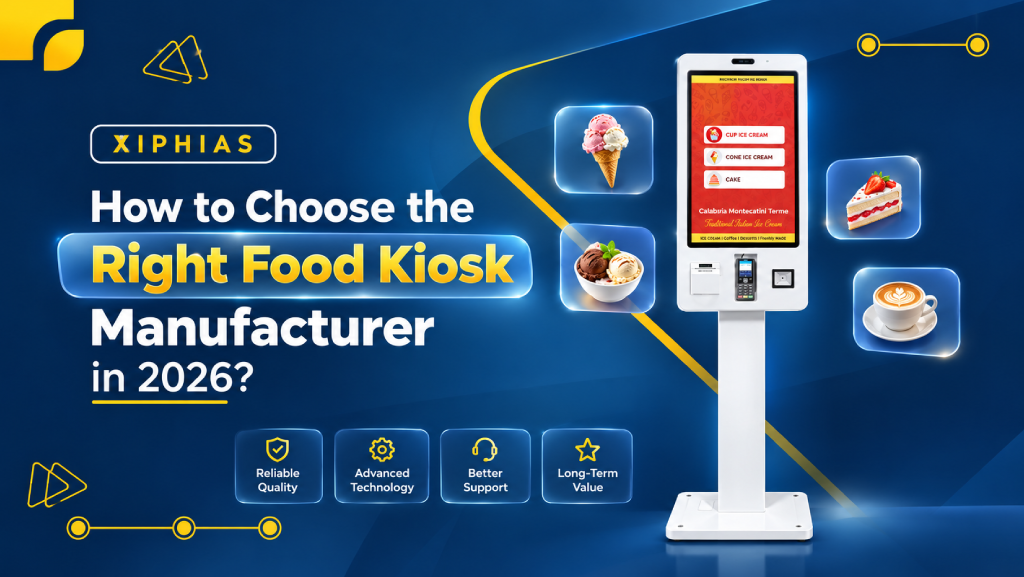
How to Choose the Right Food Kiosk Manufacturer in 2026?
To choose the right food kiosk manufacturer in 2026, define your menu and location first, then compare shortlisted suppliers on food-safe materials, customization depth, technology integration, total cost of ownership and after-sales support. Ask each one for installed examples, a dated timeline and references from clients with a similar kiosk.
Why choosing a food kiosk manufacturer matters more in 2026
Cafes, quick-service restaurants, malls, airports and campuses use food kiosks to serve customers faster, reduce staff workload and keep service consistent. As demand grows, more suppliers enter the market, and quality varies widely.
Buyers also expect more from suppliers now: reliable equipment, flexible menus, software integration and long-term service. The manufacturer you choose shapes your uptime, compliance and running costs for years.
So evaluate more than the quote. Look at materials, design support, technology, warranty and how quickly the team responds when something goes wrong.
Use the steps and scorecard below to compare suppliers fairly.
8 steps to choose a food kiosk manufacturer
- Define your concept. Write down your menu, daily volume, equipment list, staff count, power and water access, and target location (mall, airport, campus, street or event).
- Set a realistic budget range. Include design, fabrication, equipment, branding, delivery, installation, permits and a contingency for changes.
- Build a shortlist. Search “food kiosk manufacturers” plus your city or region, check industry directories and ask other operators. Aim for three to five suppliers.
- Review proof of work. Ask for photos, case studies and references of food kiosks in similar venues. A strong, consistent online presence and client reviews are early signs of reputation.
- Request the same brief from each. Send identical specifications so quotes, materials and timelines can be compared fairly.
- Check design and engineering support. Look for 3D renders, dimensioned drawings, a named project contact and a clear revision policy.
- Visit or tour the factory. Look at weld quality, finishes, quality checks and how they test electrical and plumbing before shipping.
- Compare the full package. Weigh warranty, spare parts, installation, training and service response alongside price, then sign a contract that lists specifications, milestones and payment terms.
Food kiosk manufacturer scorecard
Score each shortlisted supplier from 1 to 5 on every criterion, and add up the scores, giving more attention to the highest-priority rows. Adjust the priorities to suit your business.
| Criterion | Priority | What a 5 looks like |
|---|---|---|
| Food-safety and material quality | Highest | Food-grade stainless steel, documented specs, prior approvals in your city |
| Customization depth | High | Custom layout, branding and equipment cut-outs without fixed-model limits |
| Category experience | High | Several delivered kiosks in your food type and venue |
| Technology integration | High | Self-ordering, payments, POS and inventory integrations proven in the field |
| After-sales support | High | Written warranty, spare parts stock, fast field service, remote diagnostics |
| Total cost of ownership | Medium | Itemized quote with maintenance and software costs shown |
| Timeline reliability | Medium | Dated milestones and references confirming on-time delivery |
| Scalability | Medium | Can reproduce the same unit across multiple sites |
A supplier scoring below 3 on food safety or support should be removed from the shortlist, whatever its price.
Which type of food kiosk manufacturer fits your business?
Manufacturers specialize, so matching their model to your format narrows the shortlist quickly.
| Manufacturer type | Best for | Watch out for |
|---|---|---|
| Custom kiosk fabricator | Branded coffee, dessert, juice and street-food kiosks needing unique layouts | Longer design cycle; check food-safety experience |
| Modular or turnkey kiosk builder | Events, pop-ups, fast launches and multi-site rollouts | Limited changes beyond standard modules |
| Self-ordering kiosk provider | QSRs, cafes and food courts adding digital ordering | Hardware may be separate from the food counter |
| Vending and robotic kiosk maker | Unattended, long-hours sites such as transit hubs and workplaces | Higher upfront and maintenance cost; ask about service coverage |
| Food truck and mobile unit builder | Mobile or towable concepts | Road-safety rules and utility hookups |
If you need both a physical counter and ordering technology, ask whether one manufacturer delivers both or whether you will coordinate two vendors.
Food safety, materials and compliance checks
Food safety should be the first filter. Rules differ by country and city, so confirm requirements with your local health authority (for example, the FDA Food Code and local health departments in the US, or FSSAI licensing in India) and ask each manufacturer how its design meets them.
- Surfaces: non-porous, easy-to-clean materials such as food-grade stainless steel for prep areas and counters.
- Layout: separate prep, serving and payment zones, with handwashing and waste provisions where required.
- Utilities: correct electrical load, ventilation for cooking equipment, and water supply and drainage sized for your menu.
- Durability: impact-resistant panels, sealed joints and replaceable modular parts.
- Paperwork: material specifications, electrical diagrams and any certifications available for your market.
- Local approvals: a manufacturer that has already passed inspections in your city can save weeks of rework.
Technology and total cost of ownership
Modern food kiosks combine fabrication with software, so test the technology as carefully as the steel. Ask for demos of:
- Self-ordering and menu management: easy updates, modifiers, combos and multilingual screens.
- Payments: card, wallet and contactless options with secure processing.
- POS and inventory integration: orders reach the kitchen and stock updates automatically.
- Remote monitoring: alerts for faults, temperature and stock-outs, which help unattended or multi-site kiosks run smoothly.
- Analytics and AI features: upsell recommendations, sales dashboards and demand forecasting.
Then compare total cost of ownership over three to five years. Include:
- The kiosk, equipment, branding and installation;
- Software licenses, payment fees and updates;
- Maintenance, spare parts and service visits;
- Downtime risk if the supplier is slow to respond.
A lower quote with weak support often costs more over time than a higher quote with strong service.
Red flags when choosing a food kiosk manufacturer
- No installed examples or references in your category or venue type.
- A fixed price quoted without a written specification.
- Vague answers on materials, food-safety standards or local approvals.
- No 3D renders or dimensioned drawings before fabrication.
- Warranty, spare parts and service terms left unwritten.
- Reluctance to allow a factory visit or virtual tour.
- No clarity on who handles software updates, payments and integrations.
- Pressure to pay a large share upfront with no milestone-based schedule.
FAQs
How do I choose the right food kiosk manufacturer?
Define your menu, location and budget, shortlist three to five suppliers, and score them on food-safe materials, customization, technology, support and total cost. Ask for references from similar kiosks.
What should I look for in a food kiosk manufacturer?
Look for category experience, food-grade materials, customization options, 3D design support, payment and POS integration, a clear warranty and fast service. Proof of past projects matters most.
How much does a custom food kiosk cost?
Cost depends on size, materials, equipment, technology and installation. Manufacturers quote against a written specification, so send the same brief to several suppliers and compare itemized quotes.
How long does it take to build a food kiosk?
Lead time depends on design approval, customization and factory schedule. Ask for dated milestones covering design, fabrication, testing, delivery and installation.
Do food kiosks need health approvals?
Usually yes. Requirements vary by location, so check with your local health authority and ask the manufacturer whether it has passed inspections in your city.
What is the difference between a food kiosk and a self-ordering kiosk?
A food kiosk is a physical selling unit such as a stall, cart or booth. A self-ordering kiosk is a touchscreen terminal where customers order and pay. Some manufacturers supply both.
Are robotic food kiosks worth it in 2026?
They suit high-traffic, long-hours sites such as transit hubs and workplaces. Upfront and maintenance costs are usually higher than for a standard kiosk, so weigh them against your volume and service needs.
Should I choose a local or overseas food kiosk manufacturer?
Local suppliers simplify site visits, service and local approvals. Overseas suppliers may offer lower unit prices but add freight, customs and slower support, so compare the full cost.
Conclusion: choose a partner, not just a price
The right food kiosk manufacturer builds food-safe, customizable kiosks, integrates the technology you need and supports you after installation. Write your brief, shortlist three to five suppliers, score them with the same criteria and compare the three-to-five-year cost before you sign.
Ready to start? Share your menu, location type and budget with our team to get a custom food kiosk design and quote.